Suggestions

If you are looking for information on anything specific and cannot find it here, please leave a comment and I will sort out the information for you and post it at the earliest convenience.
Showing posts with label secrets of selling. Show all posts

Tuesday, 9 September 2014

7 Tips to Create Facebook Ads That Convert

Are you already advertising on Facebook – but not yet seeing the results you hoped for? If you want your ad spending to yield more fans, leads or sales, you might just need to tweak your strategy a little bit to start seeing a better return on investment.

Here are 7 of my favorite Facebook ad tips for tweaking your approach, so your next Facebook ad results in higher conversion rates – and more business for you.

#1 Reach More Fans Through the News Feed

The number of users accessing Facebook on mobile devices has skyrocketed in the past year – today, 60 percent of all users are visiting Facebook on their phones and tablets. This has pretty serious implications for advertisers because when users access Facebook via mobile, there is no right-hand column – which means you can’t afford not to focus at least some of your advertising on News Feed placements.
And there’s data to back that up – according to a study by SocialCode, Facebook mobile ads earn up to 2.5 times more than desktop-only ads.
To get your Facebook ads into the News Feed (specifically Page Post ads, Page Like ads and Sponsored Stories), you have to use the Power Editor. It’s different (and a little more complicated) than the ads dashboard you’re used to, but there are plenty of resources to help you learn how.
The best way to get started is by using the free Power Editor Chrome plugin.  (How to set it up: Open Chrome, install the Power Editor, and access it here. Select “all” accounts when prompted so you can access your past ads too. Facebook has created a guide to using it.) But the main feature you’ll want to pay attention to is the “Placements” feature, which enables you to take any ad (like a Page Post Ad – my favorite) and select whether you want it to go to your users’ Desktop News Feeds, Mobile-Only News Feeds, or both. When you choose one or both of these options, your ad will ONLY be seen in the News Feed and not in the right-column.
I always choose both “Desktop News Feed and Mobile-Only News Feed” to get maximum exposure in the News Feed. Why do I not choose the right-hand column as well? Since making this shift to News Feed only ads, I’ve gone from about 0.1% Click Through Rate to between 4%-7%! To put it simply, ads in the News Feed get much more engagement than ads in the right-hand column on Facebook.
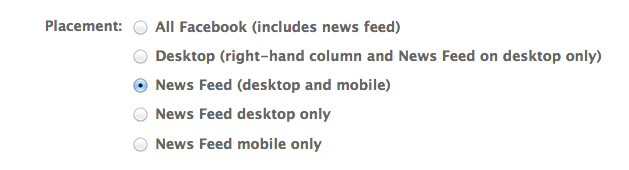
The main feature you want to pay attention to in the Power Editor is the Placement  feature, which enables you to take any ad for a Facebook Page, like a Sponsored Stories or Page Post Ad, and select whether you want your ad to go to your users’ desktop News Feeds, mobile-only News Feeds, or both. I always choose both for maximum exposure.
The main feature you want to pay attention to in the Power Editor is the Placement feature, which enables you to take any ad for a Facebook Page, like a Sponsored Stories or Page Post Ad, and select whether you want your ad to go to your users’ desktop News Feeds, mobile-only News Feeds, or both. I always choose both for maximum exposure.

#2 Jump-Start Your Lead Generation With Facebook Offers

One of my favorite things to do is to create Offers for my fans and non-fans in order to build out my email list. Offers used to be something only available to businesses with a brick-and-mortar location, and worked a lot like emailed coupons – but now any kind of business can use them.
Rather than create an Offer to sell a big product – say, a $1,500 coaching package – what I recommend is using an Offer to promote a FREE giveaway in exchange for users’ email addresses. After all, Offers get emailed right to your users – and their inbox is where YOU want to be!
So set up a simple landing page for your giveaway that requires an email and a name, and then create an Offer (with an enticing thumbnail) that links up to the landing page. Next, turn it into a Promoted Post directly via your Page wall (or, for more targeting options, go into the ads dashboard instead). You can also try targeting non-fans – or even fans of your competitors – if the Offer is juicy enough. (But see tip #7 first.)
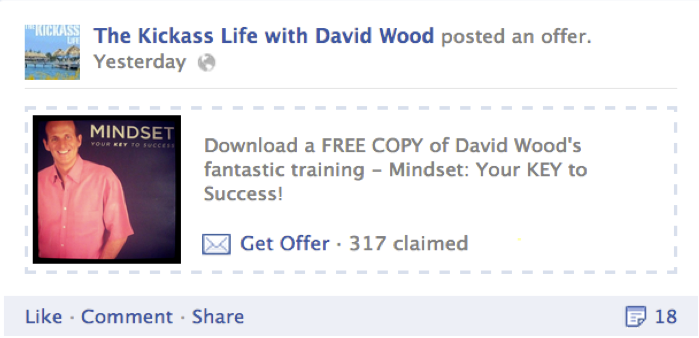
The best use of Facebook Offers is to create list-building opportunities like this example here from The Kickass Life Facebook Page.

If you want to try and drive sales vs. leads, try promoting the post to current fans (pin it to the top of your Wall for an extra push) and offering a specific dollar discount or free option, like this one:
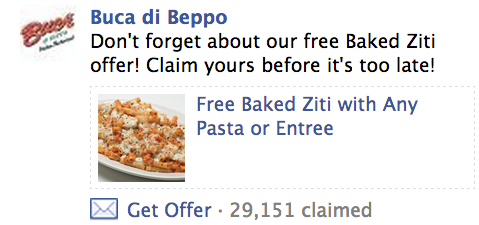
When using Facebook Offers for direct sales, such as those that promote a discount or coupon, first experiment by only posting it to your current fans.  If it's well received, then test it with a targeted non-fan segment.
When using Facebook Offers for direct sales, such as those that promote a discount or coupon, first experiment by only posting it to your current fans. If it’s well received, then test it with a targeted non-fan segment.

#3 Super-Charge Your Sales With “Custom Audiences”

 Sometimes, the conversion goal for an advertising campaign is simple: sell more.
In that case, it makes the most sense to target people who are already leads – like your email list. In the past, though, there was no convenient way to sync up your email list with your Facebook marketing.
That has since changed with the addition of the “custom audiences” feature – now you can upload your email list directly to Facebook, so that when you set up an ad, you can select them as a “custom audience” in the targeting section of the ads dashboard. Advertisers are already reporting a higher conversion rate on their ad spends (in one example cited by Facebook, an auto company saw a 24x return on their ads by using custom audiences in combination with Offers).

 #4 Save on CPC With Hyper-Targeted Advertising

If you focus most of your early marketing efforts on building a solid Facebook fan base – 5,000+ fans – you will start to see MUCH higher conversion rates right off the bat when you target fans-only in your ad campaigns. But you do need that core, solid fan base first so you have some critical mass to actually sell products or services.
How much savings can you expect? Well, as a result of targeting some of my key ads to only my own fans, I’ve paid as little as $0.07 a click – and seen FAR better conversions and sales as a result.
When you work hard to build a fan base first, you reap the rewards by getting better ad conversions…without breaking the bank!
As important as advertising is, your ability to create a thriving community – and engage them often – is the real secret sauce to getting better and better returns on your ad spending. For more tips on Facebook engagement, click here.

#5 Play by the 20-Percent Rule

Facebook recently revised their guidelines for Facebook ads that appear in the News Feed, like Promoted Posts, Offers and ads that you target to mobile Facebook users. Any image-based ad that goes out to the News Feed of users – like a still from a video advertising your next webinar, for example, or a product image offering a discount – can have a text overlay, but that text can’t take up more than 20 percent of the total ad image.
Make sure your image-based ads don’t get penalized before they get results!

What NOT to Do:
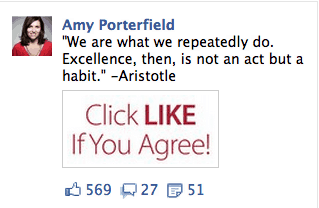
This ad will not be approved for placement in the News Feed because the ad image is more than 20% text. Instead, use ad images that are mostly graphic with minimal text.

Try This Instead:
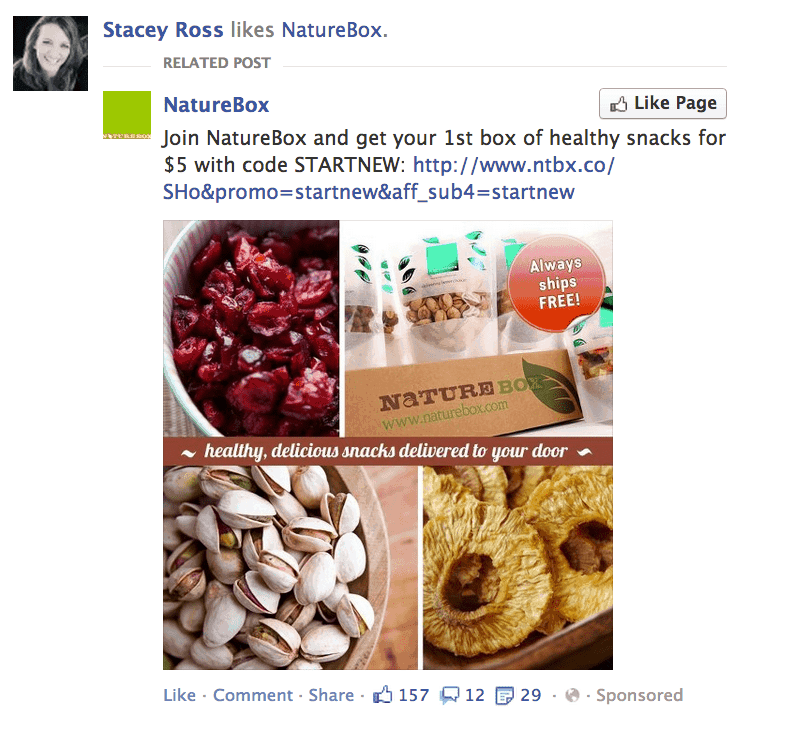
This ad image in this Page Post Ad is a great example an image with less than 20% text.  This ad would be approved for the News Feed.
This ad image in this Page Post Ad is a great example an image with less than 20% text. This ad would be approved for the News Feed.

#6 Get More Fans With the New “Like” Ads

To my point in tip #4, all businesses need a community first. Your ability to actual turn Facebook fans into leads and finally, paying customers is key to your business success — to the extent that you can keep those numbers engaged and genuinely interested, of course!
Which is where the new “Like Ads” come into play. These are designed mainly to help you grow your total number of fans, and are useful to anyone in the early stages of community building (or whenever you’re ready to grow your existing community). Unlike most ads, these “Like Ads” do well when they appear in the right-hand column, so I would not limit them just to the News Feed.
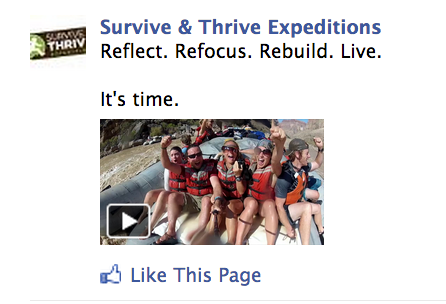
When non-fans see your Page Post Ad in the right-hand column on Facebook, they will have an opportunity to LIKE your Page directly from the ad.

To get new people interested and engaging with your brand, it’s important to establish trust and affinity up front. I know I talk about the power of video often, but this is one spot where you really want to think about leveraging video. It’s personal and it builds instant trust more than any product image, promotion or deal ever could. Keep it short, tease with one clear benefit and always include a call to action!

#7 Get Smarter With Promoted Posts

Promoting posts is a great way to get more eyeballs on your status updates. Whether your goal is engagement (maybe you asked a fun question you want fans to weigh in on), conversions (like driving fans to sign up for a free webinar in exchange for an email address) or sales, the fact is, Promoted Posts work best with one audience: yours. Your fans already know you, trust you, and want to engage with you.
A Promoted Post – and specifically, the “Sponsored Story” that gets automatically created with it – looks  a lot like spam to a user who has never liked your Page or interacted with your brand before. What would you do if you saw this in your feed and you’d never heard of the brand advertising it?
Between you and me, we’ve all seen these and thought they were tacky. But there’s a real danger that a user might complain that your Promoted Post is spam. So my best tip is toonly target fans with Promoted Posts. They are the most likely to engage and convert anyway, so why widen the net? And take that extra step to delete the Sponsored Story that gets automatically created (here’s how) too, to be extra safe. Just because some advertisers take advantage of Facebook doesn’t mean you should.

Wednesday, 13 August 2014

Psychology of Online Buyers – Web Design Tricks for an Online Store to Sell More

We are constantly manipulating human consciousness as everyday life as in business. Skilled craftsmen of a psychological impact turn us into docile audience, ready to purchase each advertised product. Online commerce thrives due to numerous methods of suggestion and direct persuasion.
Psychology of Online Buyers – Web Design Tricks for an Online Store to Sell More
First of all you need to study the ways of interaction between your website and visitors. Various surveys will be really helpful; by the way you can install heat-map plugins onto your website thus track most interesting content.
These observations will help you understand wishes of your customers and using engaging techniques given below you will increase their interaction thus you’ll enlarge your sales.
Further we’ve provided numerous psychological techniques that will stimuli your sales. For the sake of your shop learn to use these approaches and soon you’ll have a positive result of your work.

Use the knowledge of the general psychology of mass consumer

It’s known that standard selling methods, which work for supermarkets are the main strategies applied by online shops. Profit and number of visitors who make a purchase can be increased using uncomplicated marketing actions, such as:
  1. Place most profitable products to the best positions;
  2. Combine complementary product samples (wine and cheese, slippers and pajamas) in one category;
  3. Display them on a single page of search results.
And how close do complementary products coexist for you, – put them at least in a row to draw user’s attention to the fact that they may need one of those.

Start from small things

Analyze user reaction to each and every minor change in design:
  1. Changes in shape/color of buttons;
  2. Changes in color of content and background image in the header.
Free Google Website Optimizer is a great tool designed to help you ease website testing quality.

Promotion, variation of prices and interest rates

Have you read “Marketing Experiments” by Dr. Flint McGlaughlin, he said that most consumers perceive the price stated first in a row, as average and standard. That is, when announcing the sale “with discounts from 15 to 30%,” you need to realize that people will expect 15% discount on larger amount of products, and 30% for just a few ones. That’s why it’s really important to state in the header the phrase: “discount up to X%” and in general use the phrase “up to” not to confuse people. By the way, did you notice that “to” sounds more convincing than “over”? If you specify prices in dollars, better inform your visitors of minimum values, like starts “from $15″, which looks much more attractive than “$15 – $40.” However, using such ambiguous wording, you probably should ensure the availability of footnotes, which set out the terms of discounts, and set them out very clearly. Otherwise, you may experience some fracas with those customers, who didn’t delve into the matter, and the page where they can be addressed, will be an excellent proof of your innocence.
Buyers are susceptible to offers of free shipping, and can even prefer $15 shipping to a $20 discount. Try to benefit from these oddities of human thinking. Skillfully manipulating the figures and percentages, you will attract people with enticing banner ads, themes, messages when sending newsletters, etc.
I guess you’ve seen following price tags: $99.95 or $49.95. The trick is in subconscious perception of these numbers, they are closer to $90 or $40 thus against all logic, they do not distort the real value of this amount. A series of experiments showed that the goods price at $9.99, were sold twice as much as $10.00 ones! Incredible, isn’t it? This method is more suitable for consumer-Americans. Moreover, it works much better with certain product groups.

Use the principle of reciprocity

This principle is clearly described in Robert Cialdini’s “Psychology of Persuasion. In short, you wish to provide a service in respond to any courtesy. This behavioral norm has been instilled to all of us since early childhood. Our parents teach us to be polite and show appreciation for any favor, thus making us susceptible to psychological influence. They make us believe that people will not like us if we deny giving a back favor. Sale – is an analogue of the favor, to some extent it requires you reciprocal actions. Online stores offer additional bonuses, discount coupons, more expensive analogues of an exact product, in order for the customers to answer with a courtesy and buy those products. The principle is simple, as breath-in breath-out. And it’s not even the price: if raise it before Sale, anyway visitors will not come and buy.

Beautiful design web store

It’s been proved that nice-looking shop assistants sell more, and the court is more favorable to attractive people. Online store visitors are driven with same approach as judges with lacking opportunity to meet you closer, they rely on the first impression. Human subconscious ingrained an idea that beautifully decorated shops are much better that all other ones.
Use pictures that “have a character”.
Use photos that appeal to your senses, don’t forget that users “find interesting” photos with attractive individuals of both sexes. Allow your viewer to “smell the smoke”, “feel the sweat”, taste the wine and experience the embrace simply looking at those photos.
instantShift - ASOS.com
To make pictures come alive look for moments with beautiful light, pleasing back-round and most importantly, make sure that your pictures convey some kind of emotion: be it sadness, fear or happiness. It is said that eyes are the mirror of the soul so capture what you see in your subject’s eyes. Keep in mind, hands are also very expressive.

First person information presentation

According to the statistics, people are attracted to texts bearing personality imprint.
Imagine this: you open the page of a computer store, you see a bunch of products offered to you in an indifferent and detached manner, it makes you feel isolated all those buttons, images, and registry items. Wouldn’t it be more pleasant to interact with a “cart” that addresses you personally as if it’s human. You need to make your customers feel as if you want to get to know them, or show the human-like face of your brand. Positive feedback scores and chat with the audience in first person adds credibility to you as a professional, outlining your brand identity.

Simplicity and accessibility of “shorthands”

People trust only those things and notions they understand. That’s why; try to present instructions and call-to-actions clearly. Visual clues and pointers to the page of your store should be clearly visible and understandable so that users could easily find what they came for. “Interconnections” between navigation symbols of your website should give a convincing image of your company.

Upselling Offers

What’s an upselling offer? These products are usually placed on the checkout page or directly on the page with description of a goodie. You can offer additional services, facilities, advantages in terms of warranty or delivery to buyers of certain goods. What you need to do? Make an additional premium offers that will sound as real “baits”, in a good sense! For example, upselling products are usually the best choices to meet customer requirements.

Binding of prices

This technique gives you an possibility to vary various values. Prices and package are distributed the way that customers choose more expensive products, thus the difference between these products is not that high. For ex., Amazon.com offers a free “super-economy” delivery of any order worth over $25.
This is how this technique works.
If you offer a choice from three variants of designs: “web version”, “print version only” and “web + print” at prices $59, $125 and $135, respectively, you’ll notice that most customers prefer the third one. However, if you remove “print version only”, you’ll reduce your profits, since most people will choose cheaper “web version.”

Psychology of color perception as a marketing tool

Everyone knows that certain colors naturally affect emotions and human physiology, you always have to consider the characteristics of the environments that belong to your potential visitors. Colors are perceived differently on all continents and almost in all cultures. Therefore, it would be good to find out something about color theory, before you start building the layout of your future store. Competently composed color combinations will help you attract more loyal users.

Some more interesting stuff: Neuro-Marketing tips and tricks

Decision-making Process

Now let’s talk about one more interesting thing, i.e. the decision making. Do you know how humanz make decisions? If you’re not a psychologist-behaviorist, or if you are not studying psychology/behavior of primates, than this part of article will be very interesting for you.

How it works?

Human brain can be divided into numerous parts, ancient ones – that developed millions and millions of years ago and more recent ones – those we’ve obtained when got on two feet. If we did not evolve, we would still look like those proto-primates resembling squirrel from the “Ice-age”.
Decisions we make come from that ancient part of our brain, and it’s called – the Reptilian part. It responds for the basic necessities of survival: sleeping, breathing, reproduction, response to external stimuli and it controls decision-making action. That’s why it’s really important to make some actions that will appear to this part, and use the language that it understands the best. Two other brain sections, the “New Brain” and the “Middle Brain” have a supporting role.
  1. The New Brain is a pure logics, it makes deductions based on facts and data, later sharing it with other two parts.
  2. The Middle Brain produces emotions. It processes intuitions and feelings, and then shares its discoveries.
  3. The Reptilian part is a decision-maker.
Luckily you can always figure out some ways on how to influence even the most stubborn person.

Basically, there are four dead-simple tricks!

  • Diagnose the pain – reptilian part “wants” to avoid pain at any cost. Here you need to show how your product will “cure the pain” and “relieve the frustrations”;
  • Differentiate your claims – you need a hook that shows how your product stands apart from others, create a real contrast to help the Reptilian part see you as special and decide in your favor;
  • Show benefits – show it the gain it will get from choosing your product, you need to demonstrate concrete evidence of your benefits using simple and easy to understand messages;
  • Deliver your message – to complete your effective sales technique, your messages and presentations should be filled with visual stimuli and emotions that grab the attention of the Reptilian part and cause it make a buying decision in your favor.

Neuro-marketing Concept

Neuro-marketing is the latest form of marketing study aimed at studying brain’s responses to advertising including messages and images. It assumes that human brain has discrete functional areas that manage consumer behavior which is mostly driven by the subconscious. This advanced technique allows to influence our subconscious. With Neuro-marketing you can develop effective marketing mix that will satisfy consumers better (what is the main objective of marketing). Eventually Neuro-marketing study will be used to customize products and marketing communications according to the brain type of potential customers.
instantShift - Neuro-marketing Concept
Neuro-marketing study provided marketers with a secret weapon that is focused on making websites more engaging. Some of these tips can be familiar to most of us, but when used together, these tips will be your weapon of mass attraction.
  1. Too many choices – if people have too many choices they will not choose at all, that is strange but it’s the fact, the wider the range of products is, the more time user needs to choose the one (you can try to reduce the amount of similar products);
  2. Social validation – reviews and testimonials, users consider reviews of other customers more important than those submitted by the experts, or provided by the website specialists (try to engage your customers in submitting reviews considering the products they’ve acquired);
  3. Scarcity principle – if something is unavailable it is considered to be more valuable;
  4. Food, sex and danger – powerful triggers for action (feel free to use but not overuse);
  5. Power of faces – fusiform facial area, part of a brain that makes us focus on the faces of people, when using pictures of people make sure they look right;
  6. Story – information that is presented in a form of a story is processed better, you can personalize your fact presentation with your own thoughts if it is appropriate (this will be effective when presenting video reviews of the products you offer);
  7. Commitment – by asking small commitments you will get more loyal customers after some time, similar to social validation.

Conclusion

Tips provided in this article will help you increase website usability and user response, when used right they will help you achieve sky-high conversion rate and you’ll get a handle on the best way to present design and content that entices visitors and helps generate business to your company. One thing needs to be pointed out these tips won’t be helpful if you don’t have a solid product or service to begin with, so get that down first. The rest will only serve to deliver it to the consumers successfully.

Thursday, 24 July 2014

3 Secrets to a Site that Sells

So, you've got your site up. Now what? You need to drive traffic, grow your opt-in list, make sales and work on your SEO. The list seems endless.
Step back for a minute and realize it's not possible to do everything at once. Once you've built your website, the first thing you should do is make your sales process watertight.

There's no point spending a ton of cash on pay-per-click ads to drive targeted traffic to your site if none of those visitors buys anything.
Follow this three-point sales action plan before you spend a bundle on attracting visitors.
1. Get your sales copy in top shape
You've got less than five seconds to persuade people to stay on your website, so your headline has to grab them and compel them to read on. The best headlines tell visitors they've found exactly what they're searching for and make them curious enough to keep reading.
But don't let your readers slip through your fingers once you've grabbed their attention with a hot headline.
Sales copy is what turns visitors into customers. So make sure it guides people through a streamlined process that:
  • Identifies with their problem and builds your credibility
  • Engages them--and explains why you can help
  • Tells them how they'll benefit from your product
  • Overcomes any objections they may have
  • Compels them to take action--and tells them exactly what to do
Good sales copy funnels your readers through a tight sales process and doesn't give them a reason to click away. Take a look at your own and see if all the elements are in place, and if not, give it more of the attention it deserves. (Here's a more detailed article on sales copy.)
2. Collect testimonials
What's more trustworthy than a personal recommendation? A good testimonial can persuade even the most skeptical potential customer to buy from you.
Testimonials prove that your product really works--that it does exactly what you promise. And if you run a small business and haven't built your reputation, testimonials are indispensable.
Here's how to gather quality testimonials and benefit from them immediately:
  • If you don't have any customers yet, give your product away to a group of people in your target market in exchange for their feedback.
  • If you have some positive feedback from customers, contact them and ask permission to use their comments on your site.
  • Don't be afraid to ask for testimonials. Invite customers to give you their vote of confidence with an e-mail link that says, "Click here to tell us what you think!"
  • E-mail your buyers after they've purchased your product to ask them how they're enjoying it.
Try to get testimonials that are full of concrete benefits. How much money did someone save? How much time would they have spent without your product? How much better did they perform than before?
Let your visitors know these are real people. A first name, last name and location will prove it. A photo's great. And don't forget video.
You'll find dozens of opportunities to use testimonials throughout your site: on your homepage, within your sales copy, on a special testimonial page, on relevant product pages or in relevant product listings, so don't hesitate to use them where you can.
3. Make it easy to buy
I'm always amazed how many sites make it difficult for you to buy from them. According to market research from the Gartner Group, more than 50 percent of web sales are lost because visitors can't find what they're looking for. Don't make that mistake.
  • Name your navigation buttons clearly so it's obvious what people will find when they click on them.
  • Keep your navigation simple and consistent throughout your site, so people don't have to click any more than necessary. Ideally, someone should be able to buy from you in two clicks at most.
  • Use "Buy Now" buttons that link to your shopping cart or order page every time a product is shown--especially if you have a catalog site.
    And when people click to your sales page, make things easy for them.
  • Provide a range of payment options. Accepting credit cards is an absolute must, but PayPal, Google Checkout or even a downloadable mail-in form make it possible for anyone to complete a transaction.
  • On your order form, ask only for the information you need. For example, if you sell an e-book, it's unlikely you'll need a home address. The less information people have to give you, the better they like it.
  • Don't underestimate the power of including a phone number people can call if they have any questions.
Sales copy, testimonials, shopping cart. Once you've got these three crucial elements of your sales process shipshape you can confidently drive targeted traffic to your site--and know it'll convert!

Tuesday, 15 July 2014

The 7 Secrets of Internet Marketing

Businesses are spending more and more of their marketing dollars on Internet marketing. And while some aspects of Internet marketing are the same as traditional marketing, others are not. Here are seven things you need to know for your Internet marketing to be successful.
Many marketers have been shifting their marketing budgets to the web over the past few years. Marketing online allows you to target specific audiences and easily track return on investment, commonly referred to as ROI. Unlike traditional marketing methods, results of Internet marketing campaigns are almost immediate. This allows you to better evaluate what elements of your campaign are producing results and which are not. When buying online media, you must be willing to shift your marketing dollars to the online methods that produce a positive return.
To be successful at Internet marketing, you must understand the essential secrets of Internet marketing. These secrets can allow you to achieve success by finding the right audience, communicating your message properly, and leading consumers down the path to purchase. These secrets include:
1. Website Directory Listings. Before you begin any marketing campaign, make sure that the website you're promoting has been listed in the common directories such as DMOZ, Yahoo!, and Google. Even if you're using a marketing page off of the root directory of your website, be sure that the primary site is listed. This ensures that prospects can continue to find your marketing pages long after you've launched your campaign.
2. Generating Traffic. In order to realize a return on your investment, you need to generate traffic to your marketing pages. There are a number of ways to do so online. Some of the most popular include Google AdSense, Overture, and Looksmart. Other methods include affiliate programs and targeted website advertising. Research other websites that have the audience you're looking for and negotiate favorable ad rates for your online marketing campaign.
3. Marketing Pages. Don't lead prospective purchasers to a generic website. If you do, potential buyers won't know what to do next. The easier you make if for prospects to take advantage of your offer, the better. Whenever creating a marketing campaign online, provide a specific page for leading purchasers to your product or service or a billboard that showcases the offer. Take the guess work out of making a purchase and more consumers will buy.
4. Testimonials. Customer testimonials are the most powerful way to sell your product or service. When consumers hear from those who have purchased and used your product or service, they gain a certain level of trust and comfort in what you have to offer. Solicit testimonials after each purchase and use those that are the most convincing to prospective purchasers.
5. Create a Compelling Offer. Be sure to offer something that no one else is currently offering. If your offer is similar to your competitors or is not very interesting, consumers have no reason to learn more. Of course providing something for FREE is often a great way to entice potential customers. Maybe it's a 3-day free trial or a free evaluation of some kind. Be creative, try something new, and measure the response.
6. Developing Trust. Before anyone will buy from you, your website or company needs to be seen as reputable. This means that consumers can purchase from you and not worry about the safety of their credit card information, personal information, or anything else being exchanged. A good method for developing trust is to purchase and display safety and reliability icons such as BBB Online, Trust-e, and VeriSign.
7. Provide a Guarantee. Nothing makes a consumer more comfortable with a purchase than offering a guarantee. Perhaps you can offer a 100% satisfaction guarantee or a money back guarantee. A guarantee is a great way ease the risk of making a purchase. If your competitors are offering a guarantee, you want yours to be equal or better.
Internet marketing is an incredibly powerful medium for segmenting your prospects and delivering targeted advertising. Online, you can easily measure you return on investment and refine your marketing campaign over time to improve results.
If you are a local business you can benefit from Internet marketing as well. Look for local directories to list your business or service. Or, you can supplement your local advertising with product marketing pages on your website. Internet marketing is more than just placing ads online, it's using the web to communicate the value of your products and services.

Thursday, 10 July 2014

Become An Influential Figure On Social Media

Become the boss online


It is one thing committing to building a social media presence, but to become influential is a whole different beast of a task. Whether it be for the benefit of business you work for, or just for personal pleasure, being aninfluential contributor on social media feels good, but there are somethings you must do in order to reach this goal.

social media marketing
Source: digitalinformationworld.com

Focus on your expertise


Master a topic so that people trust your opinion. Make yourself the number one source of information in that specific topic and people will flock towards your profile. The key here is to go beyond the realms of just reporting news in a simplistic, journalistic manner, and create an opinion that will spark a debate in your community. Healthy debate is key here, so don’t make your views so strong that people feel that they are being forced into a belief, or even worse are suffering from attempted indoctrination.

Stay active


The biggest error to make when trying to establish yourself online is not staying active. In order to be taken seriously in a very competitive area, is important to make sure that you have social media activity going on day in day out. This ensures that your followers will see that you are constantly updating your profile, whilst dashing out the latest information. It also shows that you are a highly motivated individual, and your passion for the subject in hand is not just a flash in the pan. Even when it gets tough and the views are not coming in at the rate you want them to, persist and you will see the benefits in the long run. Remember that you are doing this for your followers who rely on you for quick, accurate information.

Establish a community 


Establish a strong community and it will take a lot to break your momentum. Seeking out other experts in your field and inviting them to your discussion will work wonders, as you will have created the most comprehensive debate in your topic. It shows supreme confidence, that you are willing to invite the competition to come and join your discussions, and sends out a message to them that you are the one to look up to in that market. If they do join up, they will no doubt attract a heavy following also, and in turn this could increase your fan base a huge amount.

social media marketing
Source: socialsteve.com

Share your content


Remember to share you content throughout social mediaIt is not just about Facebook and Twitter, so share to as many platforms as physically possible, and this way, your content gets widely read. Post the content publicly and then push it through social networks. By pushing your own content you send out warning shots that you have the ability to not only master a certain topic, but also create your own writing and opinions on it.

Creating a strong demeanour online can be tough as everybody is trying it these days, but with persistence and good knowledge of your niche, you could be influencing the social media congregation in no time.

Tuesday, 8 July 2014

5 Tips to Sell More Online

When it comes to online shopping, the single biggest barrier we face in persuading people to buy, is lack of trust [1].
In the ‘real’ world, we rely on non-verbal trust cues from face-to-face interactions to inform our decisions, and it’s thesesubconscious signals that help us make the choice as to whether or not to trust a vendor. Online, stripped of such cues, this process becomes much trickier.

Can I trust you?

If you want to persuade people to buy from you rather than from your competitors, you have to make a good first impression and build some initial trust before you can secure their custom. 

Find a Therapist

Search for a mental health professional near you.
In a study using Taiwanese online bookstores, two researchers devised an experiment to examine how initial trust is formed online, and how it affects intention to purchase [2]. To measure initial trust, they used four major categories of determinants: perceived risk, perceived technology, trust propensity and company competency.
Here’s what they found.

5 tips to boost your online sales:


1. Be useful

It may sound obvious, but the customers that perceived the website to be useful were more likely to trust the vendor and subsequently buy from them. A great example of a ‘useful’ site is Amazon – with its user ratings and reviews, recommendations and deals, it’s generally perceived as informative and useful, which is why it now dominates a huge corner of the online market.

2. Show that your site is secure

If you want to build trust, it’s important you show your customers that their payments will be secure. You can do this by using a secure prefix for your domain (https://), offering an established, reputable and familiar payment method (PayPal, Visa, Maestro, etc.), and providing the emotional security of a money-back guarantee.

3. Respect their privacy 

Privacy and the protection of our data have always been major concerns online, and it is an area that is attracting growing media coverage and concern – not least because the behavioural advertising and the tracking of user behaviours now mean that it’s easier than ever for companies to track each click, swipe or purchase we make. If you want to alleviate this pain, show your customers that their information is safe with you – disclose your cookie policy, reassure them that you won’t share their data with any third parties, and request the minimal amount of information necessary for them to successfully complete the purchase.

4. Maintain a good reputation

Research shows that over 90% of us say we trust ‘earned media’ (such as tweets, likes, ratings and personal recommendations from our friends) more than any other kind of advertising [2]. Since social media now plays such a huge role in making and breaking reputations, it’s important that you invest in yours by monitoring social media channels for chatter around your brand, maintaining good customer relationships, and creating positive, happy customer experiences from start to finish.

5. Be willing to customise 

Not only is personalization one of the hottest buzzwords du jour, it’s also what we’ve come to expect from our online shopping experiences. If you can show your customers that you’re willing to customize your service to meet their needs, it will show that you care enough about their experience and satisfaction to go the extra mile, which in turn will boost trust.

A closing note

Since online initial trust and familiarity with online purchasing both increase our intention to buy, it’s important that you build these steps into the design and functionality of your online platform.


When it comes to boosting your sales, it really is a question of trust.

Monday, 7 July 2014

How to Integrate Psychology Into Your Marketing

How do you market your company? You probably try to optimize your site for search engines, try some content and social media marketing, test out a few paid ad sources, and maybe even focus on conversion optimization.
Although those tactics can help you boost your sales, you shouldn’t focus all of your time on traffic generating strategies. One of the most effective ways you can boost your sales is to integrate psychology into your marketing.
But before I get into how you can leverage psychology, lets first define it:
Psychology is the scientific study of the human mind and its functions, especially those affecting behavior in a given context.
Now that we are all on the same page, here is how you can integrate psychology within your marketing:

Tactic #1: Get people to commit before committing

Let me explain what I mean here. There are two ways to think about a commitment within your online business. The obvious one is a customer buying your product or service. The less obvious one is to get the customer to be mentally prepared to buy from you.
If you get your visitors mentally prepared to make a purchase on your site, they are much more likely to complete the purchase. And the easiest way to do this is through your website copy.
A good example of this is Unleash Your Thin. Dr. Jonny Bowden uses this copy on his checkout page to get you to commit to the purchase:
unleash your thin
Jonny is really smart because not only is he getting you into the mindset of buying, he is also getting you to grasp that there is little to no risk committing because he will refund you your money if you are unhappy. Plus, he added a “check box” to give you the feeling that you’ve already checked the box and approved buying the product.
Unleash Your Thin isn’t the only company that is doing this. Gym Junkies used similar messaging with their software application and were able to increase sales by 16%.

Tactic #2: Future pace

The real estate industry is well known for future pacing their customers. Real estate agents will constantly drop lines like “when you have a BBQ in your new home, make sure you invite me”… even before you make an offer on a home.
What they are trying to do is to have you focus on the future outcome and not the purchase. Once you get hooked on all of the things that will happen if you go through with the purchase, you will be more likely to make the purchase.
You can also do this online with your marketing copy. Here’s a good example of how we do this at Crazy Egg:
crazy egg
By using the word “when”, we are assuming that you are already going to use Crazy Egg. If we didn’t want to future pace, we would have used the phrase“what do you get if you use Crazy Egg”. But by using future pacing within your copy we’ve found that it increases sales by 5% to 10%.

Tactic #3: Make people work for it

Just because you are selling something, it doesn’t mean anyone can have it. You can choose which customers you want to sell your products or services to by putting up roadblocks. Although this may seem counter-intuitive, in many cases it makes people work harder to buy your product or service.
mike 6 pack
If you look at the screenshot above, you’ll notice that Six Pack Shortcutsmakes you go through a mini quiz to qualify you. What a lot of companies have learned is that if they make you work to buy their product, instead of just driving you to a page where you can add the product to your shopping cart, you are more likely to convert into a customer. Why? Because they made you feel that you are one of the lucky few who made it through.
The funny thing about this method is that I’ve seen it increase and drop conversions drastically. When I tested it out on sophisticated audiences like Quick Sprout, I saw an 18% drop in conversions.
quicksprout work
But when I tested it out in non-sophisticated markets, I’ve seen an increase in conversion rates by up to 31%.

Tactic #4: The Power of Why

What’s the one thing that all kids do? They ask a ton of questions, right? And if you don’t answer their question with a sufficient answer, what happens? They keep asking it, right?
Your visitors are the same way. The difference is, if you don’t answer their questions, they don’t ask them again. They just leave.
Psychology is about understanding your customers and how they think. If you can survey them, you can figure out the concerns and questions they have. Some of these questions may be as basic as:
  • Why is your product or service so great?
  • Why should I buy from you?
  • Why should I stay on your site?
Within your copy, you should focus on answering all of these “whys” your visitors have. But the responses you give them have to be really good because if they suck, people will just leave your site.
“Stop taking two and three plates of food,” my mother said to me angrily.
I was at a wedding and seven years old. Back then, at a lot of the weddings we used to go to, the food would be pre-served on a plate. I could never get enough of those calorie-ridden platters. Waylaying different waiters, (so I would not be recognized), I’d polish 3-4 plates without blinking an eye.
Mom wasn’t impressed, and told me to stop and desist.
“Why?” I’d ask. Her stock reply was always, “It’s bad manners to do that.” This Dustbin Hoffman (yes, I do mean Dustbin and not Dustin) act obviously got her goat, but it left me unfazed. It must have bugged her more than I expected though, because in a short while Dad was peering down at my food-stuffed face.
My question remained unchanged. “WHY?”
“If you invite a hundred people to a wedding, how many would you cater for?” he asked. “A hundred,” I answered, proud of my analytical genius. “If you ate four plates,” he continued, “how many would remain?” He prompted quickly, “Ninety-six right?” I nodded vigorously. “That means some people don’t eat. If you’re so hungry, we can go out after the wedding and get something to eat, but don’t deprive others.”
In that example, the dad made sense. He made so much sense that the seven-year-old boy listened and didn’t have an issue with the answer.
If you don’t give a good explanation every time your customers ask “why”, they’ll just leave.
If you are looking for a good web-based example, check out how we answer the question of “why should I use Crazy Egg instead of Clicktale”.
clicktale
The response is so thorough that potential customers don’t ask us the question anymore.

Tactic #5: Build up anticipation

Would you rather go to a club that doesn’t have a line or one that has a line? The one with the line, right? Because if a club doesn’t have a long line, it can’t be that great.
Making people wait before you let them buy doesn’t just increase your chances of getting a sale, but it also lets you charge a premium for whatever you are selling. Just look at Apple: not only are their products expensive, but people wait in lines over night to buy their products.
There are a few strategies you can use to build up anticipation:
  • Time delay – don’t give people what they want right away. Make them wait days, weeks or months to buy from you. A good example of this is I Will Teach You To Be Rich site. Their subscribers are told about offers but typically don’t have access to buy them until the 30-day mark.
  • Applications – usually you are the one who is doing the selling, which, as you already know, doesn’t work too well. You can switch things around and build up anticipation by making people apply to buy your product or service. You’ll find that people will try to convince you to sell your product to them with this tactic.
  • Drop hints – Apple uses this strategy really well because you’ll see hints of what their products will look like or the features they will have, but you don’t know everything about the products until they want you to know about it.

Conclusion

You don’t have to make big changes to get big results. Making small adjustments to how you do your marketing, or how you portray your message, can have a positive effect on your sales.
As you learned above, replacing simple words like “if” with “when” can increase the number of sales you’re making from your site.
So, what do you think about integrating psychology into your marketing? Are their any other psychological tactics that we all should be using?