Suggestions

If you are looking for information on anything specific and cannot find it here, please leave a comment and I will sort out the information for you and post it at the earliest convenience.
Showing posts with label secrets of selling online. Show all posts

Tuesday, 9 September 2014

7 Tips to Create Facebook Ads That Convert

Are you already advertising on Facebook – but not yet seeing the results you hoped for? If you want your ad spending to yield more fans, leads or sales, you might just need to tweak your strategy a little bit to start seeing a better return on investment.

Here are 7 of my favorite Facebook ad tips for tweaking your approach, so your next Facebook ad results in higher conversion rates – and more business for you.

#1 Reach More Fans Through the News Feed

The number of users accessing Facebook on mobile devices has skyrocketed in the past year – today, 60 percent of all users are visiting Facebook on their phones and tablets. This has pretty serious implications for advertisers because when users access Facebook via mobile, there is no right-hand column – which means you can’t afford not to focus at least some of your advertising on News Feed placements.
And there’s data to back that up – according to a study by SocialCode, Facebook mobile ads earn up to 2.5 times more than desktop-only ads.
To get your Facebook ads into the News Feed (specifically Page Post ads, Page Like ads and Sponsored Stories), you have to use the Power Editor. It’s different (and a little more complicated) than the ads dashboard you’re used to, but there are plenty of resources to help you learn how.
The best way to get started is by using the free Power Editor Chrome plugin.  (How to set it up: Open Chrome, install the Power Editor, and access it here. Select “all” accounts when prompted so you can access your past ads too. Facebook has created a guide to using it.) But the main feature you’ll want to pay attention to is the “Placements” feature, which enables you to take any ad (like a Page Post Ad – my favorite) and select whether you want it to go to your users’ Desktop News Feeds, Mobile-Only News Feeds, or both. When you choose one or both of these options, your ad will ONLY be seen in the News Feed and not in the right-column.
I always choose both “Desktop News Feed and Mobile-Only News Feed” to get maximum exposure in the News Feed. Why do I not choose the right-hand column as well? Since making this shift to News Feed only ads, I’ve gone from about 0.1% Click Through Rate to between 4%-7%! To put it simply, ads in the News Feed get much more engagement than ads in the right-hand column on Facebook.
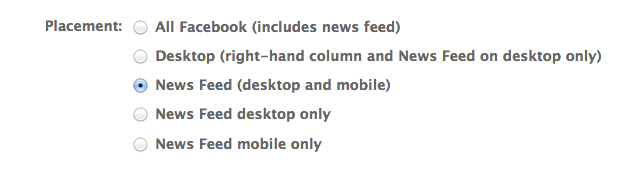
The main feature you want to pay attention to in the Power Editor is the Placement  feature, which enables you to take any ad for a Facebook Page, like a Sponsored Stories or Page Post Ad, and select whether you want your ad to go to your users’ desktop News Feeds, mobile-only News Feeds, or both. I always choose both for maximum exposure.
The main feature you want to pay attention to in the Power Editor is the Placement feature, which enables you to take any ad for a Facebook Page, like a Sponsored Stories or Page Post Ad, and select whether you want your ad to go to your users’ desktop News Feeds, mobile-only News Feeds, or both. I always choose both for maximum exposure.

#2 Jump-Start Your Lead Generation With Facebook Offers

One of my favorite things to do is to create Offers for my fans and non-fans in order to build out my email list. Offers used to be something only available to businesses with a brick-and-mortar location, and worked a lot like emailed coupons – but now any kind of business can use them.
Rather than create an Offer to sell a big product – say, a $1,500 coaching package – what I recommend is using an Offer to promote a FREE giveaway in exchange for users’ email addresses. After all, Offers get emailed right to your users – and their inbox is where YOU want to be!
So set up a simple landing page for your giveaway that requires an email and a name, and then create an Offer (with an enticing thumbnail) that links up to the landing page. Next, turn it into a Promoted Post directly via your Page wall (or, for more targeting options, go into the ads dashboard instead). You can also try targeting non-fans – or even fans of your competitors – if the Offer is juicy enough. (But see tip #7 first.)
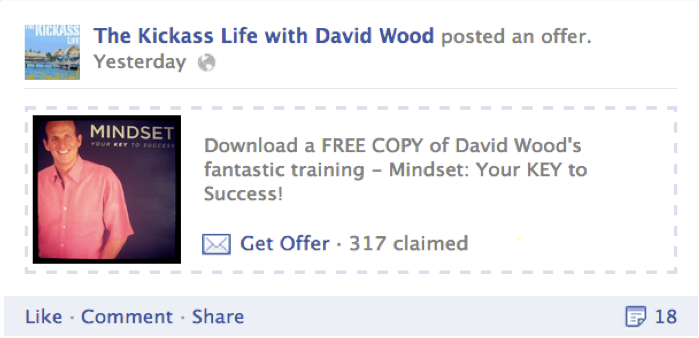
The best use of Facebook Offers is to create list-building opportunities like this example here from The Kickass Life Facebook Page.

If you want to try and drive sales vs. leads, try promoting the post to current fans (pin it to the top of your Wall for an extra push) and offering a specific dollar discount or free option, like this one:
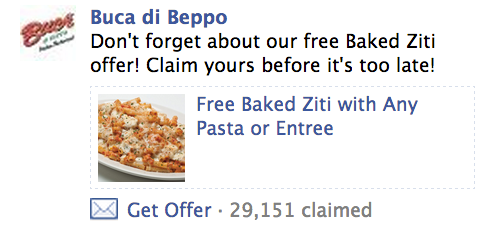
When using Facebook Offers for direct sales, such as those that promote a discount or coupon, first experiment by only posting it to your current fans.  If it's well received, then test it with a targeted non-fan segment.
When using Facebook Offers for direct sales, such as those that promote a discount or coupon, first experiment by only posting it to your current fans. If it’s well received, then test it with a targeted non-fan segment.

#3 Super-Charge Your Sales With “Custom Audiences”

 Sometimes, the conversion goal for an advertising campaign is simple: sell more.
In that case, it makes the most sense to target people who are already leads – like your email list. In the past, though, there was no convenient way to sync up your email list with your Facebook marketing.
That has since changed with the addition of the “custom audiences” feature – now you can upload your email list directly to Facebook, so that when you set up an ad, you can select them as a “custom audience” in the targeting section of the ads dashboard. Advertisers are already reporting a higher conversion rate on their ad spends (in one example cited by Facebook, an auto company saw a 24x return on their ads by using custom audiences in combination with Offers).

 #4 Save on CPC With Hyper-Targeted Advertising

If you focus most of your early marketing efforts on building a solid Facebook fan base – 5,000+ fans – you will start to see MUCH higher conversion rates right off the bat when you target fans-only in your ad campaigns. But you do need that core, solid fan base first so you have some critical mass to actually sell products or services.
How much savings can you expect? Well, as a result of targeting some of my key ads to only my own fans, I’ve paid as little as $0.07 a click – and seen FAR better conversions and sales as a result.
When you work hard to build a fan base first, you reap the rewards by getting better ad conversions…without breaking the bank!
As important as advertising is, your ability to create a thriving community – and engage them often – is the real secret sauce to getting better and better returns on your ad spending. For more tips on Facebook engagement, click here.

#5 Play by the 20-Percent Rule

Facebook recently revised their guidelines for Facebook ads that appear in the News Feed, like Promoted Posts, Offers and ads that you target to mobile Facebook users. Any image-based ad that goes out to the News Feed of users – like a still from a video advertising your next webinar, for example, or a product image offering a discount – can have a text overlay, but that text can’t take up more than 20 percent of the total ad image.
Make sure your image-based ads don’t get penalized before they get results!

What NOT to Do:
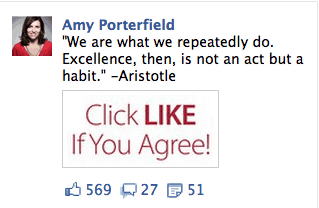
This ad will not be approved for placement in the News Feed because the ad image is more than 20% text. Instead, use ad images that are mostly graphic with minimal text.

Try This Instead:
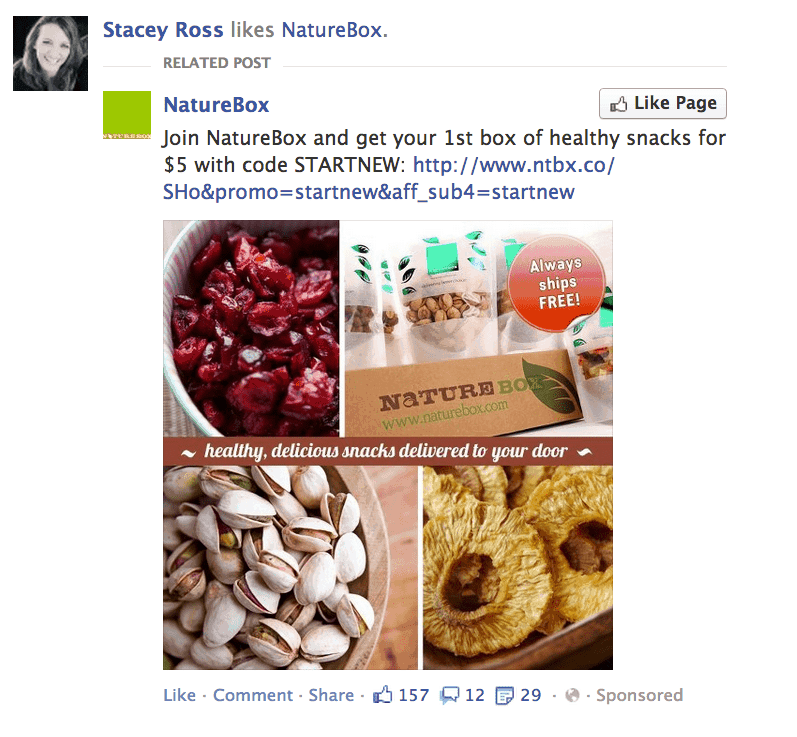
This ad image in this Page Post Ad is a great example an image with less than 20% text.  This ad would be approved for the News Feed.
This ad image in this Page Post Ad is a great example an image with less than 20% text. This ad would be approved for the News Feed.

#6 Get More Fans With the New “Like” Ads

To my point in tip #4, all businesses need a community first. Your ability to actual turn Facebook fans into leads and finally, paying customers is key to your business success — to the extent that you can keep those numbers engaged and genuinely interested, of course!
Which is where the new “Like Ads” come into play. These are designed mainly to help you grow your total number of fans, and are useful to anyone in the early stages of community building (or whenever you’re ready to grow your existing community). Unlike most ads, these “Like Ads” do well when they appear in the right-hand column, so I would not limit them just to the News Feed.
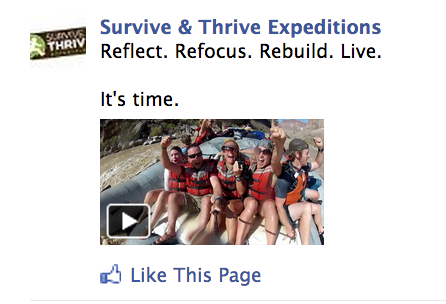
When non-fans see your Page Post Ad in the right-hand column on Facebook, they will have an opportunity to LIKE your Page directly from the ad.

To get new people interested and engaging with your brand, it’s important to establish trust and affinity up front. I know I talk about the power of video often, but this is one spot where you really want to think about leveraging video. It’s personal and it builds instant trust more than any product image, promotion or deal ever could. Keep it short, tease with one clear benefit and always include a call to action!

#7 Get Smarter With Promoted Posts

Promoting posts is a great way to get more eyeballs on your status updates. Whether your goal is engagement (maybe you asked a fun question you want fans to weigh in on), conversions (like driving fans to sign up for a free webinar in exchange for an email address) or sales, the fact is, Promoted Posts work best with one audience: yours. Your fans already know you, trust you, and want to engage with you.
A Promoted Post – and specifically, the “Sponsored Story” that gets automatically created with it – looks  a lot like spam to a user who has never liked your Page or interacted with your brand before. What would you do if you saw this in your feed and you’d never heard of the brand advertising it?
Between you and me, we’ve all seen these and thought they were tacky. But there’s a real danger that a user might complain that your Promoted Post is spam. So my best tip is toonly target fans with Promoted Posts. They are the most likely to engage and convert anyway, so why widen the net? And take that extra step to delete the Sponsored Story that gets automatically created (here’s how) too, to be extra safe. Just because some advertisers take advantage of Facebook doesn’t mean you should.

Monday, 1 September 2014

6 Psychological Triggers that Win Sales and Influence Customers

Whenever anyone asks me what marketing books I recommend that will help them sell more, the very first one I point them to is “Influence” by Robert Cialdini, published in 1984.
A professor of psychology and marketing, Cialdini lays out six ways you can get people to say yes to what you're asking. Anyone who sells things for a living, online or offline, should know, love, and live these principles:
  • Reciprocity
  • Commitment & Consistency
  • Liking
  • Authority
  • Social Proof
  • Scarcity
Let's take a look how you can build some of these influence triggers into your online store to start getting more sales and customers.

1. Reciprocity

The principle of reciprocity means that when someone gives us something we feel compelled to give something back in return. Have you ever gone to Costco ended up with an unplanned sausage purchase in your cart because you felt a nagging obligation to buy because you tried a free sample? Well, that was the principle of reciprocity in action.
Of course, online retailers can’t personally visit the house of each person who interacts with them to shove a sample in their hand. So how can you make reciprocity work for you?

Free Gift With Purchase

You might not be able to offer something in advance, but you can definitely offer something alongside. This tactic is a favorite of cosmetic and beauty products as demonstrated below by Ultra Beauty.
Even if you don’t advertise the gift in advance, slipping samples of other products into your shipped product can create the feeling of having received a gift that might earn you a second purchase.

The Gift Of Content

Content can be a good way for online retailers to provide value to potential customers—in effect, giving them a gift. For example, StyleSeek presents new users with a fun quiz they can go through to reach recommendations for clothes that match what they like:
True & Co, an online lingerie retailer, helps women figure out the right size and style of bra for them:
So whether it’s a guide for how to make the perfect vinaigrette or an exclusive author interview, use content as an ethical bribe that makes people feel grateful towards your business. 

2. Commitment & Consistency

The principle of commitment and consistency says that people will go to great lengths to appear consistent in their words and actions - even to the extent of doing things that are basically irrational.
That’s why if you’re trying to make a change in your life - losing weight, for example - it can be very helpful to state your goal publicly. Once you’ve committed out loud (or online) you will have much more incentive to keep up your end of the bargain.
As a retailer, if you can get customers to make a small commitment to your brand (like signing up for your email newsletter), they are more likely to eventually purchase from you. And if you can actually get products in their hand, even if there is no official commitment to buy them, your chances increase even more.
This is the principle behind Warby Parker’s Home Try-On Program:
Warby Parker knows that with a product that sits right in the middle of your face all day, look and fit are important. They also know that if they can get a set of frames in your hands, they are probably about 50% of the way to making a sale. So they make it as frictionless as possible - order the samples, get the box, order the frames you want, and send the box back for free. They say there's no commitment, but they are wise students of Cialdini - they know the customer feels the commitment the minute they open the box.
Zappos’ famously easy return policy is another example of this - there is less friction for the customer to buy because they know that if they don’t like it they can return it. But once they have the product in their hands, will they really return it? Probably not. They're already committed.

3. Liking

The principle of liking says that we are more likely to say yes to a request if we feel a connection to the person making it. That’s why the sausage sample lady at Costco is always giving you a nice smile.
It’s also why brands hire celebrities to endorse their products - so that people will transfer their love of Roger Federer to watches he’s endorsing.
There are lots of ways to make this principle work for your store:

Telling Your Story

As a direct-response marketer I tend not to truck much with branding. But if there’s one place that branding is essential, it is in triggering the principle of liking.
Every element of your store - colors, fonts, photo styles, copy - contributes to your brand personality, and your goal is to create a personality that is cohesive and that your target customer will like. This might be brisk and efficient if you are selling into a business market, warm and playful if you’re selling children’s products, 'earth-mothery' if you’re selling natural products.
Many stores will include something like an “About Us” page that is basically brand personality distilled. Here’s an example from Hiut Denim Co:
And one from jewelry designer Elva Fields:
This is a great way to sum up your story and to get people to like you.

Use Models People Can Identify With 

If you’re selling clothing, jewelry, or accessories, one quick way to create a connection to your customer is to show your stuff on people they will identify with and like. This doesn’t mean you need to book Russian supermodels; it’s best if they look like your customers. This might mean funky and cool, like So Worth Loving:
Casual and athletic, like Title Nine:
Or preppy, like Southern Marsh:

Social Links

People are more likely to purchase something if it’s recommended to them by someone they know and trust. So make sure that your product pages have links to Twitter, Facebook, Pinterest, and Google+ so that your customers can tell their friends about the great product they just found on your site.
I know this sounds obvious, but I had to poke around to find examples, especially with smaller stores. But tea shop Little Sparrow is doing it right:
And so are more well known brands, like Fab:

Display What Others Are Buying

Have you ever noticed someone wearing the same shoes or shirt as you and mentally saluted their fine taste? You probably felt a quick connection with that person based solely on that one data point.
Stores can play off that idea by presenting products that are similar to what the person is browsing, as seen here in the online store for the comic The Oatmeal:

4. Authority

Most people have heard of the famous Milgram experiments, in which volunteers were convinced to continue delivering what they thought were incredibly painful electric shocks to unseen subjects, even when they could hear (faked) screams of pain. The presence of a man in a lab coat telling them to continue was enough to earn the compliance of nearly all the volunteers.
People appear hard-wired to respond to authority (or the appearance of authority). How can you use this to sell?

Expert Creation

Does your product have a scientific secret sauce? Display content from professionals with credentials likeHerbalife:
Is it hand-crafted by trained artisans? Tell the world all about them like Dodocase:
And of course books are another great example of this. Are you more likely to buy a run-of-the-mill book about how to cook French Food… or one by Jacques Pepin? Cookbook Village knows that big names sell books and they have a whole section for big name chefs:

Expert Curation

These days the range of products available to a shopper are so vast it’s hard to wade through them all—and that’s why “curation” has become the buzzword of the moment.
Do you have a Chief Stylist (or someone who could reasonably pass for that)? Have a page with her top picks for the season. Selling fitness products? Have a personal trainer give his favorite picks. Even a little authority is enough; Kepler’s Books provides recommendations from each of their staff members:

5. Social Proof

The principle of social proof is connected to the principle of liking: because we are social creatures, we tend to like things just because other people do as well, whether we know them or not. Anything that shows the popularity of your site and your products can trigger a response.
Have you gotten good press? Mention it! Received loving emails from customers? Quote them! Gotten good feedback from your mom? Heck, get it up there. Look, cute tableware purveyor Camila Prada has done all three:
Another tactic is to provide a “Best Sellers” or “Most Popular” page, as demonstrated by Black Milkbelow. Are the anatomically-correct muscle leggings really their most popular, or just the ones that are most piled up in the warehouse? As a consumer, I don’t know. But by declaring these particular leggings the most wanted, Black Milk has given them a sheen of desirability.
And of course, ratings and reviews, a la Amazon & countless other retailers, are another fine way to show social proof.

6. Scarcity

Cialdini’s final principle is the principle of scarcity, which states that people are highly motivated by the thought that they might lose out on something. Call it the Eternal Teenager Principle: if someone tells you that you can’t have it - boy, do you want it. This is probably the one I’m the biggest sucker for, personally.
Marketers trigger this effect by using all kinds of tactics to suggest that products (or low prices) might soon be gone, or that someone is trying to keep this product off the market.

Deadlines For Sales

Lily Pulitzer is counting down to the second when she her summer sale prices will become unavailable.

Impending Out-Of-Stock Announcements

You want that cute toy box from ModMom? Well, you’d better hurry - there are only three left!

Seasonal or Limited Products

Every March when my friend gets her green Shamrock Shake from McDonalds she crows with happiness all over the social media. Think she’d be that excited if she could walk in and get it any time? Of course not. The knowledge that the supply is limited motivates her—and makes her feel like a success for having “won.”
And speaking of me being a sucker for this tactic, that’s exactly how I feel about my Pumpkin Spice Latte from Starbucks.


But What About Pricing?

You may be wondering where the extremely common retail tactics of sales & discounts fall under these six principles. Is Cialdini saying that price doesn’t impact people’s purchasing behavior?
Of course it does, and Cialdini mentions a couple of pricing experiments in the beginning of his book. But think of it this way: the price of your product represents the size of a risk someone is going to take on. In other words, people will be a lot more choosy over a $10,000 product than one that is $1.

Risk Removal

The six principles of influence represent additional non-obvious ways to impact perceived risk. For example, by using appeals to authority, you're decreasing the risk of a 'yes' - someone who says yes (to your appeal to buy a product) can always point to the authority you've demonstrated to rationalize their purchase. By using scarcity tactics, you're increasing the risk of a 'no' - someone who declines your offer right now might miss out.
So given a price that you have settled on for your products, using the principles of influence can decrease the risk of 'yes' (liking, social proof, authority) or increase the risk of 'no' (scarcity, consistency, reciprocity).
Sprinkle them throughout your site and watch your sales go up!

Wednesday, 13 August 2014

Psychology of Online Buyers – Web Design Tricks for an Online Store to Sell More

We are constantly manipulating human consciousness as everyday life as in business. Skilled craftsmen of a psychological impact turn us into docile audience, ready to purchase each advertised product. Online commerce thrives due to numerous methods of suggestion and direct persuasion.
Psychology of Online Buyers – Web Design Tricks for an Online Store to Sell More
First of all you need to study the ways of interaction between your website and visitors. Various surveys will be really helpful; by the way you can install heat-map plugins onto your website thus track most interesting content.
These observations will help you understand wishes of your customers and using engaging techniques given below you will increase their interaction thus you’ll enlarge your sales.
Further we’ve provided numerous psychological techniques that will stimuli your sales. For the sake of your shop learn to use these approaches and soon you’ll have a positive result of your work.

Use the knowledge of the general psychology of mass consumer

It’s known that standard selling methods, which work for supermarkets are the main strategies applied by online shops. Profit and number of visitors who make a purchase can be increased using uncomplicated marketing actions, such as:
  1. Place most profitable products to the best positions;
  2. Combine complementary product samples (wine and cheese, slippers and pajamas) in one category;
  3. Display them on a single page of search results.
And how close do complementary products coexist for you, – put them at least in a row to draw user’s attention to the fact that they may need one of those.

Start from small things

Analyze user reaction to each and every minor change in design:
  1. Changes in shape/color of buttons;
  2. Changes in color of content and background image in the header.
Free Google Website Optimizer is a great tool designed to help you ease website testing quality.

Promotion, variation of prices and interest rates

Have you read “Marketing Experiments” by Dr. Flint McGlaughlin, he said that most consumers perceive the price stated first in a row, as average and standard. That is, when announcing the sale “with discounts from 15 to 30%,” you need to realize that people will expect 15% discount on larger amount of products, and 30% for just a few ones. That’s why it’s really important to state in the header the phrase: “discount up to X%” and in general use the phrase “up to” not to confuse people. By the way, did you notice that “to” sounds more convincing than “over”? If you specify prices in dollars, better inform your visitors of minimum values, like starts “from $15″, which looks much more attractive than “$15 – $40.” However, using such ambiguous wording, you probably should ensure the availability of footnotes, which set out the terms of discounts, and set them out very clearly. Otherwise, you may experience some fracas with those customers, who didn’t delve into the matter, and the page where they can be addressed, will be an excellent proof of your innocence.
Buyers are susceptible to offers of free shipping, and can even prefer $15 shipping to a $20 discount. Try to benefit from these oddities of human thinking. Skillfully manipulating the figures and percentages, you will attract people with enticing banner ads, themes, messages when sending newsletters, etc.
I guess you’ve seen following price tags: $99.95 or $49.95. The trick is in subconscious perception of these numbers, they are closer to $90 or $40 thus against all logic, they do not distort the real value of this amount. A series of experiments showed that the goods price at $9.99, were sold twice as much as $10.00 ones! Incredible, isn’t it? This method is more suitable for consumer-Americans. Moreover, it works much better with certain product groups.

Use the principle of reciprocity

This principle is clearly described in Robert Cialdini’s “Psychology of Persuasion. In short, you wish to provide a service in respond to any courtesy. This behavioral norm has been instilled to all of us since early childhood. Our parents teach us to be polite and show appreciation for any favor, thus making us susceptible to psychological influence. They make us believe that people will not like us if we deny giving a back favor. Sale – is an analogue of the favor, to some extent it requires you reciprocal actions. Online stores offer additional bonuses, discount coupons, more expensive analogues of an exact product, in order for the customers to answer with a courtesy and buy those products. The principle is simple, as breath-in breath-out. And it’s not even the price: if raise it before Sale, anyway visitors will not come and buy.

Beautiful design web store

It’s been proved that nice-looking shop assistants sell more, and the court is more favorable to attractive people. Online store visitors are driven with same approach as judges with lacking opportunity to meet you closer, they rely on the first impression. Human subconscious ingrained an idea that beautifully decorated shops are much better that all other ones.
Use pictures that “have a character”.
Use photos that appeal to your senses, don’t forget that users “find interesting” photos with attractive individuals of both sexes. Allow your viewer to “smell the smoke”, “feel the sweat”, taste the wine and experience the embrace simply looking at those photos.
instantShift - ASOS.com
To make pictures come alive look for moments with beautiful light, pleasing back-round and most importantly, make sure that your pictures convey some kind of emotion: be it sadness, fear or happiness. It is said that eyes are the mirror of the soul so capture what you see in your subject’s eyes. Keep in mind, hands are also very expressive.

First person information presentation

According to the statistics, people are attracted to texts bearing personality imprint.
Imagine this: you open the page of a computer store, you see a bunch of products offered to you in an indifferent and detached manner, it makes you feel isolated all those buttons, images, and registry items. Wouldn’t it be more pleasant to interact with a “cart” that addresses you personally as if it’s human. You need to make your customers feel as if you want to get to know them, or show the human-like face of your brand. Positive feedback scores and chat with the audience in first person adds credibility to you as a professional, outlining your brand identity.

Simplicity and accessibility of “shorthands”

People trust only those things and notions they understand. That’s why; try to present instructions and call-to-actions clearly. Visual clues and pointers to the page of your store should be clearly visible and understandable so that users could easily find what they came for. “Interconnections” between navigation symbols of your website should give a convincing image of your company.

Upselling Offers

What’s an upselling offer? These products are usually placed on the checkout page or directly on the page with description of a goodie. You can offer additional services, facilities, advantages in terms of warranty or delivery to buyers of certain goods. What you need to do? Make an additional premium offers that will sound as real “baits”, in a good sense! For example, upselling products are usually the best choices to meet customer requirements.

Binding of prices

This technique gives you an possibility to vary various values. Prices and package are distributed the way that customers choose more expensive products, thus the difference between these products is not that high. For ex., Amazon.com offers a free “super-economy” delivery of any order worth over $25.
This is how this technique works.
If you offer a choice from three variants of designs: “web version”, “print version only” and “web + print” at prices $59, $125 and $135, respectively, you’ll notice that most customers prefer the third one. However, if you remove “print version only”, you’ll reduce your profits, since most people will choose cheaper “web version.”

Psychology of color perception as a marketing tool

Everyone knows that certain colors naturally affect emotions and human physiology, you always have to consider the characteristics of the environments that belong to your potential visitors. Colors are perceived differently on all continents and almost in all cultures. Therefore, it would be good to find out something about color theory, before you start building the layout of your future store. Competently composed color combinations will help you attract more loyal users.

Some more interesting stuff: Neuro-Marketing tips and tricks

Decision-making Process

Now let’s talk about one more interesting thing, i.e. the decision making. Do you know how humanz make decisions? If you’re not a psychologist-behaviorist, or if you are not studying psychology/behavior of primates, than this part of article will be very interesting for you.

How it works?

Human brain can be divided into numerous parts, ancient ones – that developed millions and millions of years ago and more recent ones – those we’ve obtained when got on two feet. If we did not evolve, we would still look like those proto-primates resembling squirrel from the “Ice-age”.
Decisions we make come from that ancient part of our brain, and it’s called – the Reptilian part. It responds for the basic necessities of survival: sleeping, breathing, reproduction, response to external stimuli and it controls decision-making action. That’s why it’s really important to make some actions that will appear to this part, and use the language that it understands the best. Two other brain sections, the “New Brain” and the “Middle Brain” have a supporting role.
  1. The New Brain is a pure logics, it makes deductions based on facts and data, later sharing it with other two parts.
  2. The Middle Brain produces emotions. It processes intuitions and feelings, and then shares its discoveries.
  3. The Reptilian part is a decision-maker.
Luckily you can always figure out some ways on how to influence even the most stubborn person.

Basically, there are four dead-simple tricks!

  • Diagnose the pain – reptilian part “wants” to avoid pain at any cost. Here you need to show how your product will “cure the pain” and “relieve the frustrations”;
  • Differentiate your claims – you need a hook that shows how your product stands apart from others, create a real contrast to help the Reptilian part see you as special and decide in your favor;
  • Show benefits – show it the gain it will get from choosing your product, you need to demonstrate concrete evidence of your benefits using simple and easy to understand messages;
  • Deliver your message – to complete your effective sales technique, your messages and presentations should be filled with visual stimuli and emotions that grab the attention of the Reptilian part and cause it make a buying decision in your favor.

Neuro-marketing Concept

Neuro-marketing is the latest form of marketing study aimed at studying brain’s responses to advertising including messages and images. It assumes that human brain has discrete functional areas that manage consumer behavior which is mostly driven by the subconscious. This advanced technique allows to influence our subconscious. With Neuro-marketing you can develop effective marketing mix that will satisfy consumers better (what is the main objective of marketing). Eventually Neuro-marketing study will be used to customize products and marketing communications according to the brain type of potential customers.
instantShift - Neuro-marketing Concept
Neuro-marketing study provided marketers with a secret weapon that is focused on making websites more engaging. Some of these tips can be familiar to most of us, but when used together, these tips will be your weapon of mass attraction.
  1. Too many choices – if people have too many choices they will not choose at all, that is strange but it’s the fact, the wider the range of products is, the more time user needs to choose the one (you can try to reduce the amount of similar products);
  2. Social validation – reviews and testimonials, users consider reviews of other customers more important than those submitted by the experts, or provided by the website specialists (try to engage your customers in submitting reviews considering the products they’ve acquired);
  3. Scarcity principle – if something is unavailable it is considered to be more valuable;
  4. Food, sex and danger – powerful triggers for action (feel free to use but not overuse);
  5. Power of faces – fusiform facial area, part of a brain that makes us focus on the faces of people, when using pictures of people make sure they look right;
  6. Story – information that is presented in a form of a story is processed better, you can personalize your fact presentation with your own thoughts if it is appropriate (this will be effective when presenting video reviews of the products you offer);
  7. Commitment – by asking small commitments you will get more loyal customers after some time, similar to social validation.

Conclusion

Tips provided in this article will help you increase website usability and user response, when used right they will help you achieve sky-high conversion rate and you’ll get a handle on the best way to present design and content that entices visitors and helps generate business to your company. One thing needs to be pointed out these tips won’t be helpful if you don’t have a solid product or service to begin with, so get that down first. The rest will only serve to deliver it to the consumers successfully.